
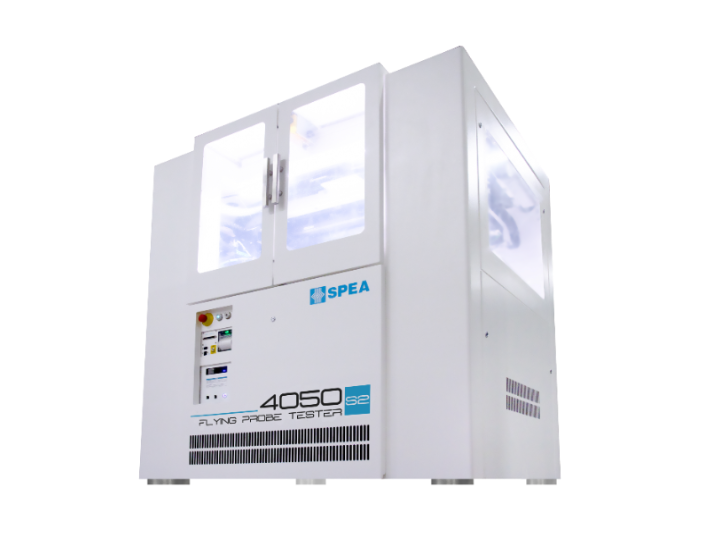
High productivity with maximum accuracy
SPEA 4050 Flying Probe Tester – Ideal for medium-volume production
Highlights of the SPEA 4050 Flying Probe Tester
- High throughput
- High precision measurements
- Precise contacting of Micro-SMD
- No adapter costs
- Intuitive programming
- Highest error coverage
- Reduction of field returns
Multi-mode contacting
With the SPEA 4050, the 4 flying test heads on the top can be combined with additional test tools on the bottom. This increases test depth and throughput.
Each of the test probes can be used for an in-circuit test, a power-on test, as an analog sink/source, as a digital driver/sensor, for flashing using on-board programming, boundary scan, and can be used as a divider.
The four needles at the top can be used for a standard flying probe test, while the lower platform can be used to accommodate additional fixed probes and adapters, various power supplies, digital I/O signals, and support fingers. The 4 test needles from above can also be equipped with additional test tools.
Precise contacting of Micro-SMD
The miniaturization of components continues to advance – SPEA flying probe testers are equipped to handle it.
High-performance linear motors on all axes (X, Y, Z)
Precise contacting of micro-SMD (008004)
Reliable testing of flexible/thin assemblies
Sticky boards during product ramp-up
Unique repeatability even with the smallest components over a long period of time
Ultra-fast soft-touch technology: no damage from contacting, no stress or strain on the assembly and components
High-precision measurements with the SPEA 4050 Flying Probe Tester
- High-precision measurement performance and accuracy (0.1pF)
- Signal integrity
- No impairment of the measurement results or interference
- Immediate signal acquisition
High test speed
- High-performance linear motors on all axes (X, Y, Z)
- Maximum speed for all movements
- Maintenance-free: No impairment of accuracy due to wear and tear
- Extreme long-term stability and durability

